
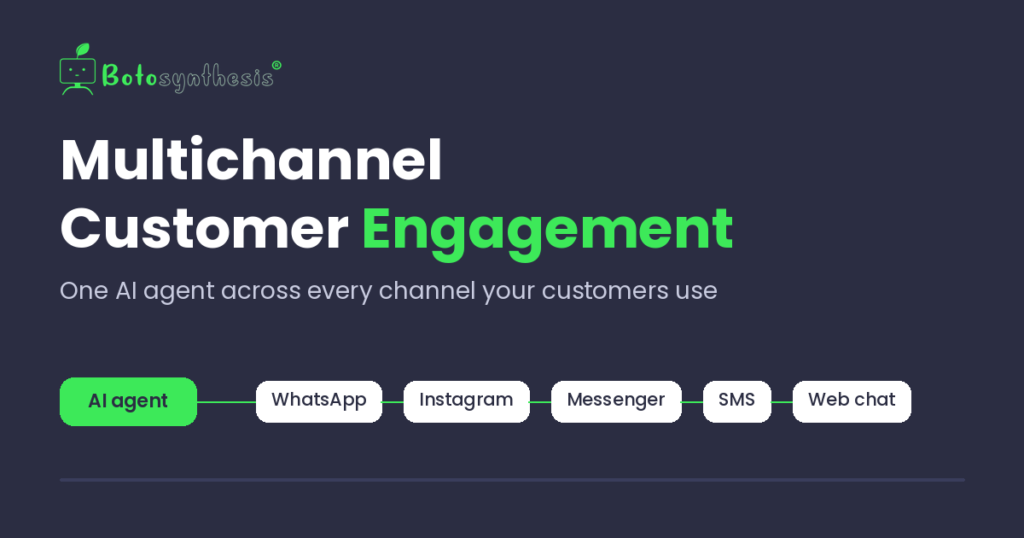
A customer sees your post on Instagram and sends a DM. Another finds your website at 11 pm and types into the chat box. A third calls your number because they’re driving. If your AI agent only answers on one channel, two of those three people wait for a human, and some of them never come back.
That’s the business case for multichannel customer engagement: being available, and useful, on the channels your customers actually use. In this guide we focus on outcomes, not set-up: more leads caught, lower running cost, a calmer team and consistent answers. We also cover when a single channel is honestly enough.
If you want the product view first, how one bot and one knowledge base serve every channel, read our guide to the omnichannel chatbot.
What multichannel customer engagement means for a small business
Multichannel customer engagement means customers can reach you on several channels and get a real answer on each. For most growing businesses today, those channels are:
- Instagram DMs
- Facebook Messenger
- Telegram
- Website chat
- SMS
- Voice calls
The difference that matters is how you cover them. One option is a separate tool, or nobody at all, on each channel. The other is one AI agent that answers on all of them, with every conversation landing in one shared inbox for your team. The second is what this post means by “one agent across channels”.
Reach customers where they already are
People use whatever is already open: the app they were scrolling, the site they were reading, the phone in their hand.
Research backs this up. In an Alvarez & Marsal and CII survey of 2,019 Indian consumers across 54 cities, 73% said they explore multiple channels while shopping, and 64% complete purchases across two or more channels to fulfil a single need. (Source: Alvarez & Marsal India, 19 March 2026)
So answering on only one channel asks many customers to change their habit before they can talk to you. Many will just move on.
Each channel tends to bring a different kind of contact:
- Social DMs often come from people who just discovered you through a post, a reel or an ad. See Instagram automation.
- Website chat catches visitors who are already comparing prices or reading your service pages. See website chatbot.
- Telegram suits communities, channels and groups. See Telegram chatbot.
- SMS and voice calls reach people who prefer not to use apps, or who simply want to call.
One agent across all of them means each of these people gets an answer in the place they chose.
The leads a single-channel setup quietly loses
Lost leads from a single-channel setup rarely show up in a report. Nobody logs the DM left unanswered for two days.
Here’s where they usually slip away:
- After hours. A message arrives at night on a channel your bot doesn’t cover. By morning the customer has asked someone else.
- The “wrong” channel. Your bot handles one app well, but enquiries from your website or social profile sit in a separate inbox that someone checks now and then.
- Calls that go to voicemail. A caller who can’t get through often won’t leave a message, let alone call twice.
- No follow-up questions. Even when someone replies, they may answer the question and forget to ask for the name, need, budget or a booking slot.
An AI agent on every channel closes these gaps in the same way everywhere. It replies straight away, asks the qualifying questions you set, saves the details to the contact, and books or hands off to your team. The lead is captured whichever door the customer walked through.
One inbox: what it does for cost and for your team
With separate tools, more channels means more logins, more subscriptions and more places for a chat to be missed.
One agent with one shared inbox changes the maths in three ways.
Fewer tools to pay for and maintain. You’re not buying and updating a separate bot per channel. You build your flows once and connect each channel to them.
The agent handles the routine, on every channel. Hours, prices, delivery areas, booking slots and order status don’t need a person, whether they arrive by DM, web chat or call. Your team only sees the chats that need them.
Your team works from one screen. Every conversation, from every channel, is in the same inbox. Chats can be assigned to a person or team, and when the agent hands off, your teammate sees what was already said, so the customer doesn’t repeat themselves.
AI usage does cost money per conversation, and channels such as WhatsApp have their own message pricing. If WhatsApp is one of your channels, see our breakdown of WhatsApp API pricing in India. The point isn’t that more channels are free. It’s that one agent and one inbox keep the extra cost of each new channel small.
The same answer on every channel
When each channel is handled separately, answers drift. The website bot has the new price; the DM replies still quote last month’s offer. Customers notice.
With one agent, there’s one set of business information behind every reply: your services, prices, policies and hours. Update it once and every channel uses the new version. Your instructions also travel with it: what the agent may promise, what it must never discount, and when to call in a human.
Not sure whether you need a menu bot or an AI agent behind it? Compare an AI agent vs FAQ bot.
Single-channel vs one agent on every channel
| Single-channel setup | One AI agent across channels | |
|---|---|---|
| Who you can reach | Only customers who use that one channel | Customers on WhatsApp, Instagram, Messenger, Telegram, web chat, SMS and voice |
| After-hours enquiries on other channels | Wait for a person, or are missed | Answered straight away |
| Lead details | Collected only on one channel | Collected the same way on every channel |
| Team workload | Several apps, or chats ignored | One shared inbox with handoff |
| Answers | Can differ by channel | One set of business information |
| Adding a channel | New tool or new build | Connect it to the same agent |
When a single channel is fine
More channels aren’t always better. A single channel is often the right call when:
- Almost all your enquiries already come from one place. Check where your last few hundred chats came from before adding anything.
- You’re just getting started. Get one channel answering well, then expand.
- Your team is very small. Every channel still produces handoffs. If nobody can pick them up in reasonable time, leave that channel for later.
- Your use case is narrow. A flow that only sends order or appointment updates may not need to live anywhere else.
A good rule: add a channel when customers are already trying to reach you there.
How Botosynthesis runs one AI agent across seven channels
Botosynthesis is a no-code platform for building AI agents. You connect WhatsApp, Instagram, Messenger, Telegram, website chat, SMS and voice calls, and every conversation lands in one shared inbox.
- Build once in the visual workflow builder. Combine AI replies with buttons, conditions and follow-up steps, then use the same agents on the channels you connect.
- Bring your own AI. Connect OpenAI, Gemini, Claude or xAI (Grok) with your own API key. Usage is billed by your provider directly to your account.
- Capture leads into the built-in CRM. Names, numbers, emails and answers are saved to the contact, with tags and pipelines for follow-up.
- Hand off with full history. The agent passes a chat to a teammate with everything that was said. Your team can take over with one click and hand it back to the agent.
FAQ
What is multichannel customer engagement?
It means customers can reach your business on several channels, such as WhatsApp, Instagram, Messenger, Telegram, website chat, SMS and voice calls, and get a useful answer on each one.
Is one AI agent across channels better than a WhatsApp-only bot?
Often, yes, if your customers also use other channels. One agent answers everywhere with the same information and sends every chat to one inbox, so fewer leads are missed. If nearly all your enquiries come through one app, a single channel can be enough to start.
Does adding more channels mean hiring more staff?
Not necessarily. The AI agent handles routine questions on every channel, and your team only picks up handoffs in one shared inbox. Still, only add channels your team can cover when a person is needed.
How do I keep answers the same on every channel?
Use one agent with one set of business information. When you update a price, policy or opening hours, every channel uses the new version.
Which channels does Botosynthesis support?
WhatsApp, Instagram, Facebook Messenger, Telegram, website chat, SMS and voice calls, all managed from one shared inbox with bot-to-human handover.
The bottom line
Customers will keep choosing the channel that’s easiest for them. One AI agent across those channels catches leads a single-channel setup misses, keeps your team in one inbox and gives the same answer everywhere. Start where your customers already are, and add channels as the demand shows up.