
If your WhatsApp bill jumped in October 2026, you are not imagining it. Meta changed its rules on 1 October 2026, and some messages that used to be free now cost money.
Here is the short answer on WhatsApp API pricing in India: Meta now charges ₹0.8631 per marketing message and ₹0.115 per utility, authentication or service message, counted per delivered message. Two things changed on 1 October: service replies are charged after the first 1,000 free each month, and utility templates sent inside the 24-hour window are no longer free.
This guide explains what you pay Meta, what changed, when messages are still free, and why your invoice can still be higher than Meta’s rate card.
WhatsApp API pricing in India at a glance (effective 1 Oct 2026)
These are Meta’s official India rates in rupees, from the INR rate card linked on Meta’s WhatsApp pricing page. You pay them for every message that is delivered to a customer with an Indian (+91) number.
| Message category | What it is | Meta rate per delivered message (INR) |
|---|---|---|
| Marketing | Offers, launches, cart reminders, re-engagement | ₹0.8631 |
| Utility | Order updates, payment receipts, appointment reminders | ₹0.115 |
| Authentication | One-time passwords (OTPs) and login codes | ₹0.115 |
| Authentication-international | OTPs sent by eligible businesses from outside India | ₹2.4971 |
| Service | Free-form replies to a customer within 24 hours | ₹0.115 (first 1,000/month per number free) |
Meta can only change these rates on the first day of a quarter: 1 January, 1 April, 1 July or 1 October. We will update this post when the rates change.
How Meta charges: per message, not per conversation
Since 1 July 2025, Meta charges per message rather than per 24-hour conversation. You pay only for messages that are actually delivered, not for messages you send that never arrive (Meta).
The 4 categories you pay for
Every message you send falls into exactly one category, and it is charged once at that category’s rate. Marketing, utility and authentication messages are templates: pre-approved formats you can send at any time. Service messages are normal free-form replies.
Templates vs free-form replies and the 24-hour window
When a customer messages you, a 24-hour customer service window opens. It resets every time they message again. Inside that window you can reply freely. Outside it, you can only reach the customer with an approved template.
Messages from customers are free
Meta does not charge for messages a customer sends to you. You only pay for messages your business sends to them.
What changed on 1 October 2026
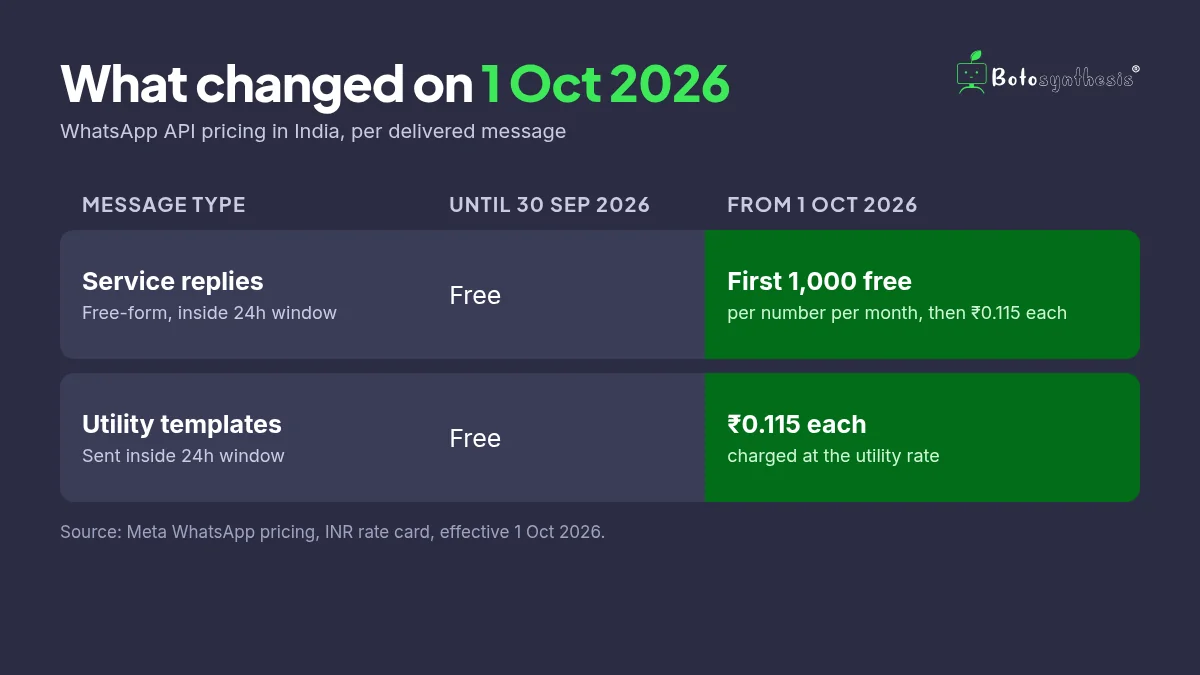
| Message type | Until 30 Sep 2026 | From 1 Oct 2026 (India) |
|---|---|---|
| Service replies (free-form, in 24h window) | Free (since 1 Nov 2024) | First 1,000 per number per month free, then ₹0.115 each |
| Utility templates inside the 24h window | Free (since 1 Jul 2025) | ₹0.115 each |
Service replies: charged after 1,000 free per number each month
Each business phone number gets 1,000 free delivered service messages per month. Meta charges from the 1,001st. Unused free messages do not roll over, and the count resets every month (Meta).
If you have two WhatsApp numbers, each one gets its own 1,000.
Utility templates inside the 24-hour window are no longer free
Earlier, if a customer messaged you and you replied with an order update template inside the window, it cost nothing. Now that message is charged at the utility rate, ₹0.115 in India.
No payment method meant no service messages
Meta said that businesses without a payment method on file by 30 September 2026 would stop having their service messages delivered once they became chargeable on 1 October (Meta). If your replies suddenly stopped going out, check your billing setup first.
Also note that eligible Indian businesses must move their WhatsApp messaging accounts to INR billing by 31 December 2026. From 1 January 2027, Meta will stop delivering messages from those businesses’ non-INR accounts (Meta).
When WhatsApp messages are still free
Free entry point window (Click-to-WhatsApp ads)
If a customer messages you from a Click-to-WhatsApp ad and you reply within 24 hours, a free entry point window opens. It lasts up to 7 days. During it, your marketing, utility, authentication and service messages to that customer are all free (Meta). This applies to customers using the WhatsApp Android or iOS app, not desktop or web.
Your 1,000 free service messages each month
The first 1,000 service replies per business number each month are free. For many small businesses, that covers a large share of everyday customer chats. An AI agent can answer routine questions so you spend fewer paid template messages.
Worked example: a month’s bill for an Indian D2C brand
Say you run a skincare brand with one WhatsApp number. In one month you send:
| Messages | Volume | Billable | Rate (INR) | Meta cost |
|---|---|---|---|---|
| Marketing (festive offer broadcast) | 5,000 | 5,000 | ₹0.8631 | ₹4,315.50 |
| Utility (order and shipping updates) | 3,000 | 3,000 | ₹0.115 | ₹345.00 |
| Service (customer replies) | 3,000 | 2,000 (first 1,000 free) | ₹0.115 | ₹230.00 |
| Total paid to Meta | 11,000 | 10,000 | ₹4,890.50 |
Notice that marketing is about 88% of the bill even though it is under half the messages. A marketing message in India costs about 7.5 times as much as a utility message.
Your numbers will be different. Run your own numbers in the WhatsApp pricing calculator →
Why your bill is higher than Meta’s rate card
If your invoice shows more than the maths above, the difference usually comes from your WhatsApp platform, not from Meta.
Per-message markup
Many businesses use WhatsApp through a software platform. Markups are typically 10–26% on some platforms, added on top of Meta’s rate per message. It is often shown as one combined per-message price, so it is easy to miss.
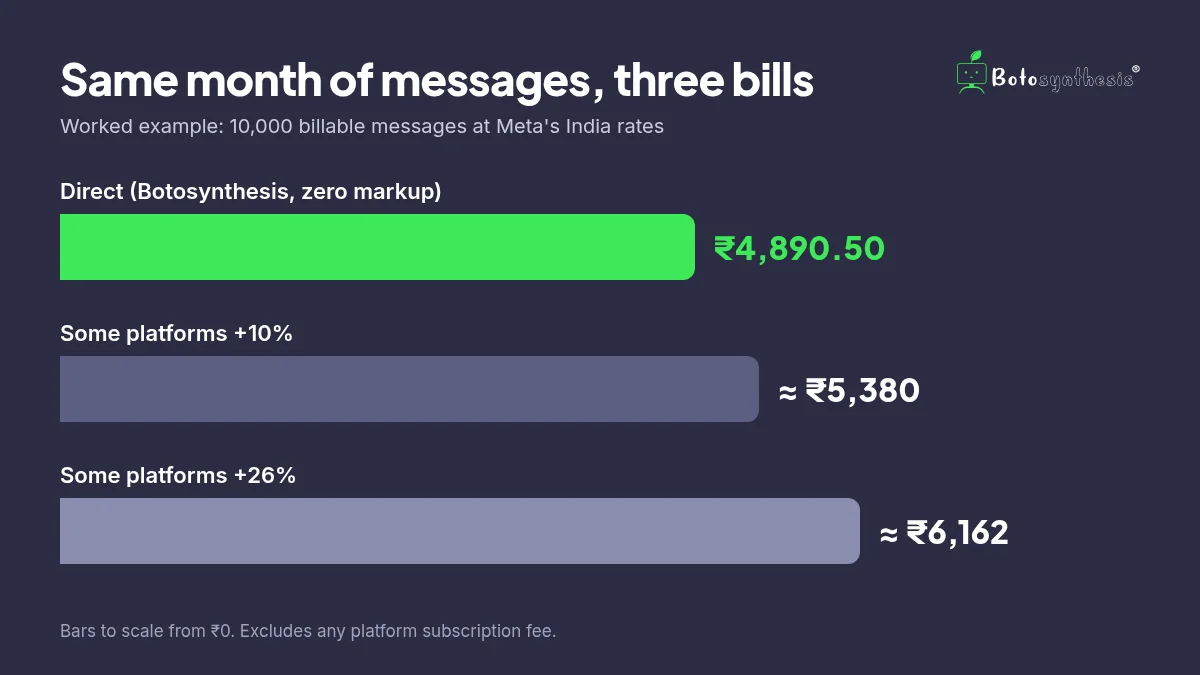
| Billing model | Same month’s messaging cost |
|---|---|
| Meta rates only (no markup) | ₹4,890.50 |
| With a 10% markup | ≈ ₹5,380 |
| With a 26% markup | ≈ ₹6,162 |
On a bigger send, that gap grows every month.
Flat per-message fees and subscriptions
Some platforms charge a fixed fee per message instead of a percentage, plus a monthly plan. A small flat fee hardly matters on a marketing message, but it can nearly double the cost of an Indian utility message at ₹0.115.
Templates in the wrong category
If a plain order update is approved as a marketing template, you pay ₹0.8631 instead of ₹0.115. Check how your templates are categorised.
How to check your invoice
- Note the per-message rate you were charged for each category.
- Compare it with Meta’s INR rate card above or on Meta’s WhatsApp pricing page.
- Any difference is your platform’s layer. Ask them to show it separately.
Zero markup: how Botosynthesis bills WhatsApp messages
At Botosynthesis, we add zero markup on WhatsApp messaging. Meta bills you directly at its own rates, so the price you see in the table above is the price you pay for messages.
Botosynthesis is a no-code WhatsApp chatbot builder made in India. One inbox covers WhatsApp, Instagram, Messenger, Telegram and web chat. Want one AI agent across WhatsApp, Instagram, Messenger, Telegram and your website? See how an omnichannel chatbot works. AI agents run on your own OpenAI, Gemini, Claude, xAI or DeepSeek keys, so you also see your AI costs directly. More than 100 businesses use it. Deciding between an AI agent or a simple FAQ bot? Read our comparison.
You can try it with a free 10-day trial. No card needed.
5 ways to lower your WhatsApp API bill
- Categorise templates correctly. Transactional updates should be utility, not marketing.
- Use Click-to-WhatsApp ads. Replies in the free entry point window cost nothing for up to 7 days.
- Answer common questions in fewer messages. A WhatsApp chatbot that answers FAQs clearly cuts back-and-forth replies.
- Watch your 1,000 free service messages. Track usage per number so the charges after the limit don’t surprise you.
- Choose a zero-markup platform. Then you pay Meta’s rates and nothing extra per message.
Frequently asked questions
How much does the WhatsApp Business API cost per message in India?
From 1 October 2026, Meta charges ₹0.8631 per marketing message and ₹0.115 per utility, authentication or service message in India, counted per delivered message.
Are WhatsApp service messages still free?
Partly. Each business phone number gets 1,000 free service messages a month. From the 1,001st, Meta charges ₹0.115 per message in India. Unused free messages do not roll over.
Are utility messages free inside the 24-hour window?
No longer. Since 1 October 2026, utility templates sent inside an open customer service window are charged at the utility rate, ₹0.115 in India.
When is WhatsApp messaging free?
Messages customers send to you are free. Your replies in a free entry point window, which lasts up to 7 days after a customer messages you from a Click-to-WhatsApp ad, are free. So are the first 1,000 service messages per number each month.
Why is my WhatsApp API bill higher than Meta’s rates?
Platform markup is typically 10–26% on some platforms, added on top of Meta’s charge, and some platforms add flat fees or subscriptions. Botosynthesis adds zero markup because Meta bills you directly.
The bottom line
In India, Meta’s rates are low, but the 1 October 2026 changes mean more of your messages are now charged. Know your categories, use the free windows, and make sure you are paying Meta’s rate rather than a marked-up one. To see your own monthly cost, use the WhatsApp pricing calculator.
Rates verified against Meta’s WhatsApp pricing page on 22 October 2026. Last updated: 22 October 2026.