
When customers message you, the same questions come up again and again. What are your hours? Do you deliver to my area? How much does it cost? So a chatbot can answer these for you, day and night, and that is where the AI agent vs chatbot question starts.
But “chatbot” covers two very different tools, which is why AI agent vs chatbot is worth a closer look. An FAQ bot answers fixed questions through menus and keywords. An AI agent understands free text, answers from your own business information, and can take actions such as booking a slot or qualifying a lead.
Choosing between them comes down to how much the bot should understand and do. This guide compares an AI agent vs chatbot built on FAQs, side by side. AI is not always the right answer. The goal is to help you pick what fits your stage.
What is an FAQ bot?
An FAQ bot is a rule-based chatbot. First, you decide the questions in advance and write the answers. Then customers tap a button, pick a menu option or type a keyword such as “price” or “hours”, and the bot replies with the answer you set.
As a result, it does exactly what you built and nothing else. If a customer types something you did not plan for, the bot either shows the menu again or passes the chat to a person.
What is an AI agent?
An AI agent is a chatbot that reads what the customer actually wrote, in their own words. It answers using the information you give it, such as your services, prices, policies and opening hours, instead of a fixed script.
However, it can also do things, not just reply. A typical AI agent can:
- Book an appointment or a call by collecting the details it needs.
- Qualify a lead by asking a few questions about budget, timeline or need.
- Hand off to a human when the question is sensitive, complex or the customer asks for a person.
AI agent vs chatbot: side-by-side comparison
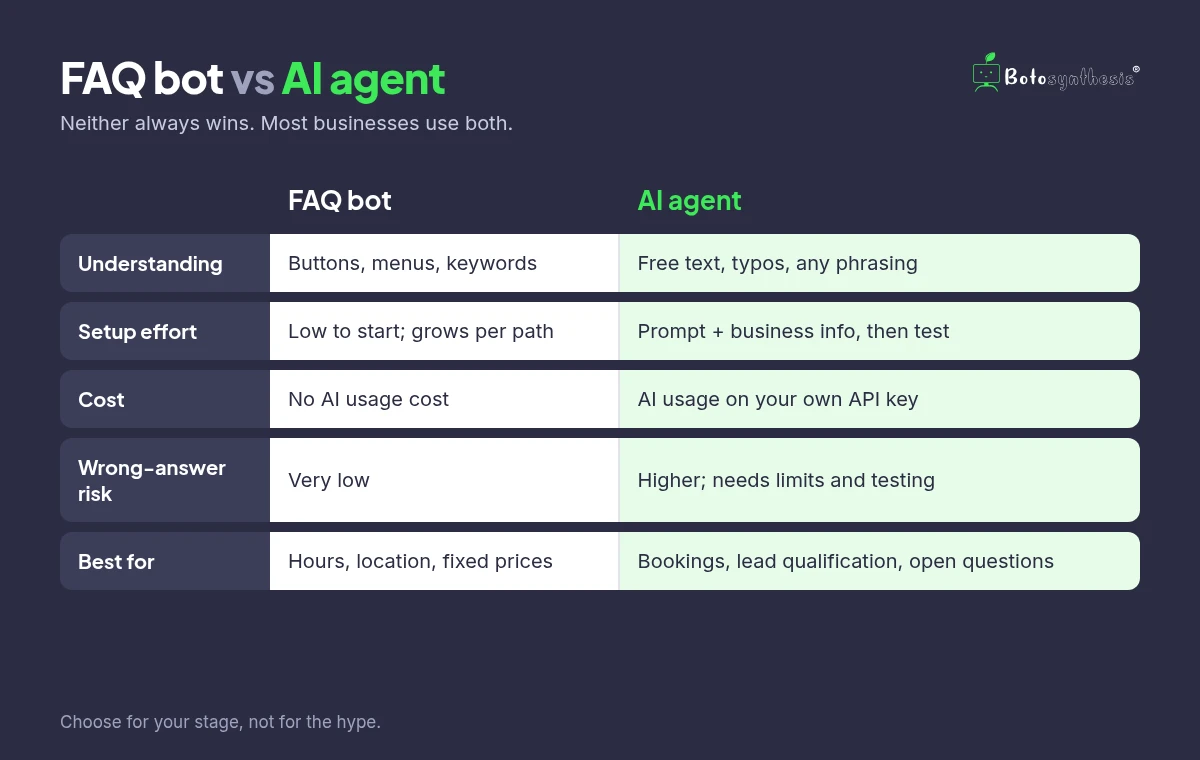
| FAQ bot | AI agent | |
|---|---|---|
| Understanding | Buttons, menus and exact keywords | Free text, typos and different phrasings |
| Setup effort | Low for a few questions; grows with every new path | Write a clear prompt and add your business info, then test |
| Cost | No AI usage cost | AI usage cost per chat, paid to your AI provider |
| Risk of wrong answers | Very low: it only says what you wrote | Higher: it can misread a question or get a detail wrong, so it needs good info, limits and testing |
| Best use cases | Hours, location, order status menus, fixed price lists, opt-ins | Open questions, bookings, lead qualification, varied product or service queries |
When an FAQ bot is enough
An FAQ bot is often the smart first step. Choose one when:
- Your questions are predictable. Most chats are about hours, address, delivery areas or a short price list.
- Answers must be exact. Refund rules, legal wording or fixed prices should not be rephrased.
- You are just starting. So you want something live this week, with nothing to tune.
- Volume is low. A person can pick up the few chats the menu does not cover.
- You want zero AI cost. There is no AI provider bill at all.
In fact, many small businesses run happily on a menu bot for months. If customers find their answer in two taps, you do not need more.
When you need an AI agent
However, move to an AI agent when the menu starts getting in the way. Signs to watch for:
- Customers ignore the buttons and type full sentences instead.
- Your menu keeps growing and is now several levels deep.
- Questions vary a lot, for example across many products, services or locations.
- You lose leads after hours because nobody asks the follow-up questions.
- Your team spends time booking slots and collecting the same details by hand.
An AI agent handles these better because it does not need a path for every question. Instead, it reads the message, checks your information and replies, or takes the next step.
Set limits for your AI agent
In short, treat an AI agent like a new team member. First, give it accurate, up-to-date business info. Then tell it what not to answer, such as discounts it cannot approve. Also, test it with real customer questions before going live, and send anything risky to a person.
The hybrid approach most businesses use
In short, the AI agent vs chatbot choice is not either-or. Most businesses end up with a hybrid that mixes both:
- Menus for the fixed stuff. Buttons for hours, location, order status and opt-ins, where exact answers matter.
- AI for open questions. When a customer types something the menu does not cover, the AI agent answers from your info.
- Humans for the rest. Complaints, special requests and high-value deals go to your team.
This keeps answers exact where they must be, keeps AI cost down because simple taps never reach the AI, and still catches the questions a menu would miss.
How it works on Botosynthesis
Botosynthesis is a no-code chatbot builder. You can build an FAQ bot, an AI agent or a hybrid in one place and use it across your channels, WhatsApp included. Want one AI agent across WhatsApp, Instagram, Messenger, Telegram and your website? See how an omnichannel chatbot works.
Build your own AI agent in the visual workflow builder
Drag and connect steps in the visual workflow builder. For example, add menus and buttons for fixed answers, then add an AI agent step for free-text questions, bookings and lead qualification. You decide where each conversation goes.
Bring your own OpenAI or Gemini API key
Connect your own OpenAI or Gemini API key. Your AI provider bills you directly for usage, and Botosynthesis adds no markup on AI usage. Some platforms charge AI credits on top; here you see the provider’s real cost.
Human handoff in the inbox
When a chat needs a person, the bot hands it off to your team in the inbox. As a result, your agent sees the conversation so far and replies from there, so the customer does not have to repeat themselves.
Frequently asked questions
What is the difference between an AI agent and a chatbot?
A rule-based chatbot, or FAQ bot, answers fixed questions through menus and keywords. An AI agent understands free text, answers from your business information and can take actions such as booking, qualifying leads or handing off to a human.
Is an AI agent always better than an FAQ bot?
No. An FAQ bot is cheaper, faster to set up and has a very low risk of wrong answers. It is enough when questions are predictable. An AI agent is better when questions vary or you need bookings and lead qualification.
Can I use an FAQ bot and an AI agent together?
Yes. Most businesses use a hybrid: menus for fixed answers, an AI agent for open questions, and human handoff for complex chats.
What does an AI agent cost to run?
On top of your platform plan, you pay for AI usage. On Botosynthesis you use your own OpenAI or Gemini API key, so your AI provider bills you directly and we add no markup on AI usage. If you run it on WhatsApp, see how WhatsApp API pricing works in India.
Can the AI agent hand a chat to a person?
Yes. On Botosynthesis the bot can hand off a conversation to your team in the inbox, where they can see the chat so far and reply.
AI agent vs chatbot: choose for your stage
First, start with an FAQ bot if your questions are simple. Add an AI agent when customers type more than they tap, or when you need bookings and lead qualification. Most teams settle on a hybrid, with a person always one step away.